
The CDG asks for your consent: We would like to process your pseudonymised data about the use of the website for analysis purposes in order to understand how visitors use our website so that we can make it even better and more intuitive. We use the open-source software Matomo for this purpose. By clicking on "accept all" you can give us your consent for this. You can revoke your consent at any time with effect for the future. You can withdraw your consent at any time by clicking the button "Customise cookie settings" and unchecking the "Analyse" box. The legality of the processing carried out up to that point is not affected by the cancellation.
Without your consent, we will only process your data to the extent technically necessary to display the website to you. Information on the required data processing and the technically required cookies can be found after clicking on the "Settings" button under "Required cookies" and in our privacy policy.
JR Centre for Advanced real-time models for digital twins of metal forming processes
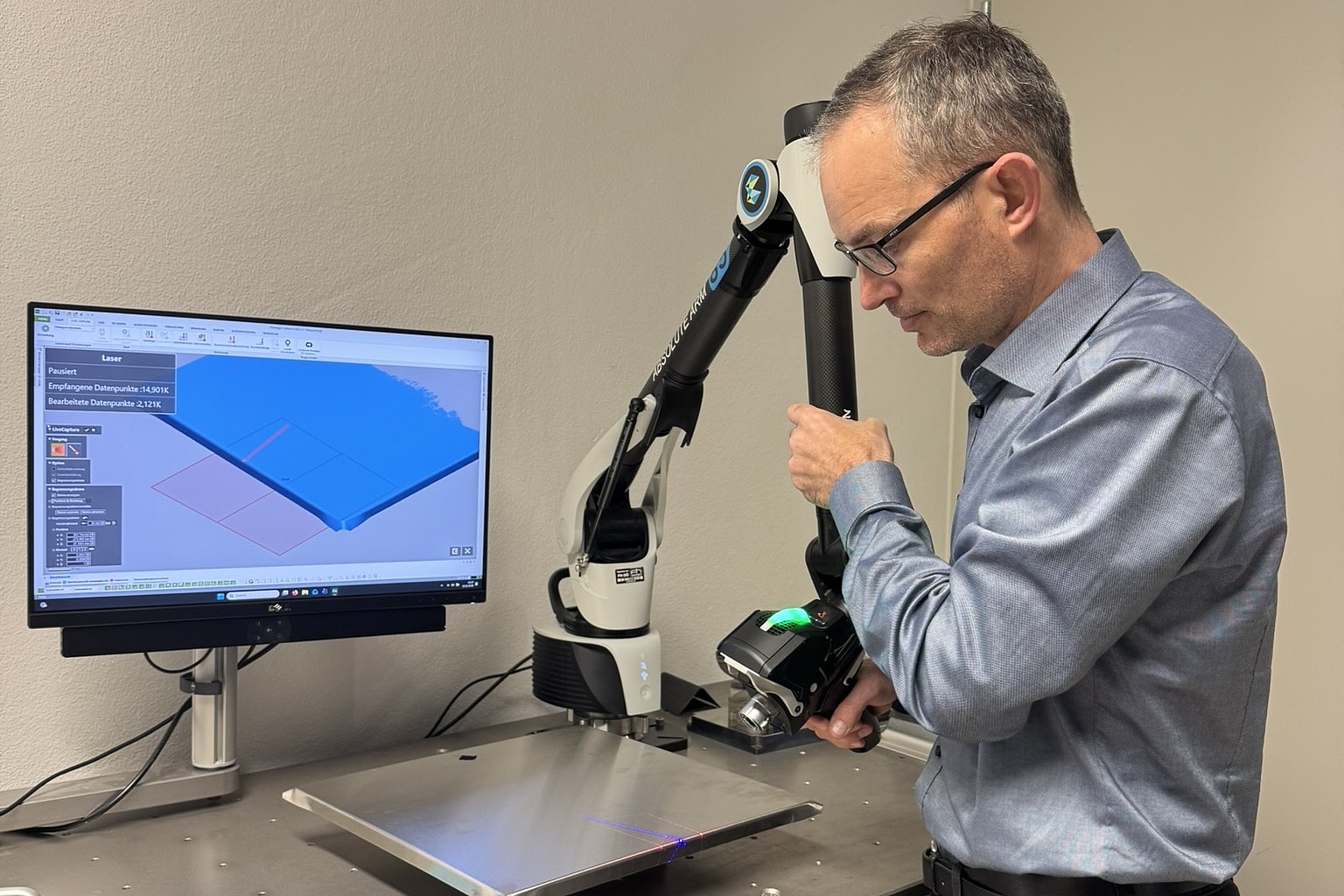
This JR Centre focuses on the creation of real-time capable models for digital twins in the challenging field of complex forming processes.
Digital twins can be used to ensure efficient, reliable operation of industrial processes and, ideally, further improve them. These are virtual representations of these physical processes and systems in which they take place. Valuable information can be extracted from such digital twins and then used for decision-making, control, adaptation and optimisation of real-world processes.
For successful industrial application, the virtual representations must be real-time capable, i.e. they must be able to provide the necessary information within the process-relevant time limits – and this in turn becomes more challenging as the complexity of the processes under consideration increases: These are complex forming processes in which effects such as large deformation or non-linear material behaviour (e.g. in elasto-plasticity) occur. The JR Centre is therefore working on enabling digital twins for such processes as well.
A classical approach would be to represent the forming process by a Finite Element model (i.e. representing the process using differential equations and solving these equations with numerical methods) and determining the necessary information by simulating the process: However, the simulation times are far from meeting industrial real-time requirements. A well-known hybrid approach is to perform time-consuming simulations offline and use machine learning to create less complex but real-time-capable models. However, this approach has the drawback that the computational effort increases too much and becomes uneconomical if there are too many parameters or the parameter range is not sufficiently known.
The JR Centre is therefore researching possible solutions without these disadvantages: one promising approach, for example, is to resolve a basic parameter range in advance using numerical simulations and to represent variations in certain parameters using analytical models. Subsequently, the database can be dynamically expanded using machine learning methods.
The JR Centre considers the digital twin of an automatic panel bender as a specific industrial application and focuses on two research topics in this context. The first topic is dedicated to the online identification of elasto-plastic material parameters of the sheet metal from measured process data, and the real-time model approach is intended to enable highly accurate production, even if the exact sheet metal material is not known: First, at the start of a bending process, the actuator forces are measured and the material is identified. Based on this information, not only are the ideal process adjustments determined within just one second, but they are also implemented in order to adapt the ongoing process accordingly. To this end, an analytical model is to be developed that represents the effects of parameter variances on the bending force and the deformed profile. The starting point and framework for this is beam and plate theory, which describes the behaviour of slender and thin mechanical structures under load.
The second research topic concerns wear, the main reason for decreasing accuracy over time and the biggest problem for achieving the industrial goal of maintaining production quality over the entire service life. This area of research at the JR Centre therefore focuses on modelling wear, determining wear parameters and compensating for the effects of wear: The models developed in this way are intended to form the basis for condition monitoring and predictive maintenance in the digital twin, with real-time limits for these functionalities in the low seconds range to enable continuous online monitoring of the production process.
The basic research at the JR Centre will therefore make an important contribution to enabling industrial production processes that are ideally adapted to raw materials and conditions and to the quality of the end products, which will benefit both industry and end customers alike.